

Most people assume vein problems start with a dramatic, bulging varicose vein. In practice, the first signal is usually a feeling. Legs that ache by afternoon. An ankle that swells by evening. A patch of skin near the calf that itches for no clear reason. By the time something is visible on the surface, the problem has typically been building for a while.
What makes vein disease easy to miss is that the most significant damage often occurs in veins that cannot be seen from the outside. The valve failure that causes every downstream symptom — a process called venous reflux — happens beneath the surface. Surface signs are only part of the picture.
Chronic venous insufficiency affects an estimated 1 in 20 adults, and varicose veins affect approximately 1 in 3.1 Many people do not realize they have a problem until the signs are already well advanced. Knowing what to look for at every stage is what makes early treatment possible.
One clarification before we go further: the blue or green tint of a normal visible vein is a trick of light through skin, not a warning sign. What makes a vein unhealthy is not how it looks from the outside. It is whether it is functioning correctly.
Healthy vs. Unhealthy Veins: Key Differences
Before looking at how vein disease progresses, it helps to understand what separates a normal visible vein from one that is no longer working properly.
| Feature | Healthy Vein | Unhealthy Vein |
|---|---|---|
| Appearance | Flat, barely visible beneath the skin | Raised, twisted, or bulging above the skin |
| Color | Blue or green (a trick of light, not a sign of disease) | Dark blue-purple, or surrounded by brownish skin discoloration near the ankle |
| Texture | Smooth, not palpable at rest | Firm, rope-like, or tender when pressed |
| Symptoms | None | Aching, heaviness, cramping, itching, swelling |
| Behavior | Veins that bulge during exercise then return flat are normal | Veins that stay raised at rest, or never return flat, signal a problem |
| Surrounding skin | Normal color and texture | Discolored, dry, thickened, or prone to a recurring rash near the ankle |
In my experience, patients often assume their leg symptoms — the heaviness and the aching by end of day — are just aging or too many hours on their feet. That assumption leads to delays that matter. Vein disease is progressive, and the earlier we evaluate it, the more straightforward the treatment tends to be. – Dr. Yan Katsnelson, MD, Founder and CEO, USA Vein Clinics
Early Warning Signs: What You Feel Before Anything Is Visible
Most people develop vein disease symptoms before a single varicose vein appears. The body signals trouble first through sensation, and those signals are frequently dismissed as tiredness, aging, or too much time on your feet. They are worth taking seriously precisely because they show up first.
A vein specialist can detect a problem using duplex ultrasound even when legs look completely normal. If any of the following are persistent or getting worse, evaluation is warranted.
- Leg heaviness. A weighted, difficult-to-lift feeling in both legs by late afternoon — especially after a day of standing or sitting — is one of the most consistent early complaints. It happens because blood pools in the lower legs when vein valves begin to weaken.
- Cramping and restless legs at night. When pooled blood irritates the nerves in the lower leg muscles, the result is often cramps that wake you up, or the relentless urge to move your legs that prevents sleep. Vein disease is a significantly underrecognized cause of both.
- Dull throbbing or pressure in the calf. This tends to worsen in warm weather and toward the end of the day. Heat causes veins to dilate; weakened valves struggle to compensate, increasing pooling and pressure.
- Itching or tingling near the inner ankle. When blood begins to leak from compromised veins into surrounding tissue, the immune system responds with histamines — producing an itch with no apparent skin cause.
What Vein Disease Looks Like: From First Signs to Advanced Stages
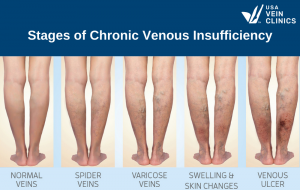
Vein disease follows a progression. The stages below move from the first visible signs on the skin’s surface to more serious complications that develop when the condition goes untreated for years. Most people are diagnosed in the early stages, when treatment is most straightforward.4
| Stage | What You See or Feel | What It Means |
|---|---|---|
| No visible signs | Legs may feel heavy, achy, or tired but nothing shows on the surface | Valve function may already be impaired. A vein ultrasound can detect the problem at this stage. |
| Spider veins | Thin, flat red, blue, or purple web-like lines on the thighs, calves, or behind the knees | A sign that venous pressure is building. Often the first thing you can see. |
| Varicose veins | Twisted, raised, rope-like veins bulging above the skin surface | Significant valve failure and blood pooling. Aching, fatigue, and cramping are common at this stage. |
| Leg swelling | Persistent ankle and lower leg swelling that builds through the day and improves overnight | Fluid escaping into surrounding tissue from sustained pressure in the veins. |
| Skin discoloration or rash | Brownish or rust-colored discoloration near the ankles; red, scaly rash that keeps coming back | Frequently mistaken for a skin condition. The source is damaged veins, not the skin itself. |
| Skin thickening | Leathery or woody texture on the lower leg; skin feels tight and hard | The skin and underlying tissue are breaking down from long-term venous pressure. Advanced stage. |
| Healed wound | A wound near the ankle that has closed but left scarred or discolored skin | A sign of prior severe damage. High risk of the wound reopening without ongoing treatment. |
| Open wound | A non-healing sore on the lower leg or ankle, often weeping or crusted | Requires prompt specialist care. Will not heal on its own without treating the underlying vein problem. |
Source: NCBI StatPearls, CEAP Classification of Venous Disorders (Zegarra and Tadi, 2023)4
A Closer Look at Each Stage
Spider Veins: The First Visible Sign
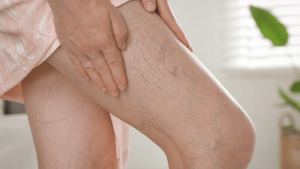
Spider veins are small, flat clusters of dilated vessels visible through the skin — typically red, blue, or purple — that form when elevated pressure forces smaller surface vessels to expand. They appear most often on the thighs, calves, and behind the knees.
They sit flush with the skin, do not bulge, and usually cause no pain, though some people notice mild itching or a faint burning sensation near the ankles. They are often dismissed as a cosmetic issue. But spider veins form because pressure is building beneath the surface — and they may appear years before varicose veins develop. That window is when treatment is simplest.
Varicose Veins: When the Vein Itself Changes Shape
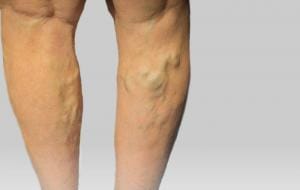
Varicose veins are enlarged veins that have lost their structural integrity from sustained pressure and blood pooling. Unlike spider veins, they protrude above the skin surface. They typically appear as twisted, rope-like veins along the inner calf or thigh.
On lighter skin tones they usually appear dark blue or blue-purple. On medium to darker skin tones the color difference may be subtle, but the vein will feel raised and is often tender when pressed. Anyone experiencing the symptoms below should seek evaluation even if nothing obvious is visible.
Varicose veins frequently cause physical symptoms that go well beyond appearance:
- A persistent aching or throbbing — not sharp pain but a dull, heavy discomfort that worsens the longer you stand
- Leg fatigue that sets in noticeably earlier in the day than it used to
- Itching or burning that runs along the path of the vein
- Cramping at night, sometimes severe enough to interrupt sleep
- A sensation of fullness in the lower leg that eases when you elevate your feet
Varicose veins are not a cosmetic inconvenience. They are a sign of chronic venous insufficiency and, left untreated, they progress.
Mid- and Advanced-Stage Signs: When the Skin Changes
As vein disease progresses without treatment, the effects extend beyond the veins themselves. Sustained pressure damages the surrounding skin and tissue. The following signs indicate that vein disease is well-established and needs medical attention.
Leg Swelling
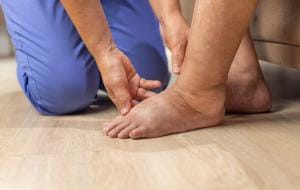
When veins cannot return blood efficiently to the heart, fluid escapes into the surrounding tissue, producing persistent swelling in the lower legs, ankles, and feet. It builds through the day and typically improves after a night of rest with your legs elevated.
A simple self-test: press two fingers firmly into the swollen area and hold for 15 seconds, then release. If an indentation remains visible for several seconds rather than springing back immediately, that is called pitting edema — a clear sign that fluid is sitting in the tissue rather than circulating.
If one leg is noticeably more swollen than the other, seek evaluation promptly. Rapid swelling in one leg, particularly with warmth, redness, or pain, can also be a sign of a blood clot (deep vein thrombosis) — a condition that requires same-day evaluation.
Skin Discoloration Near the Ankles
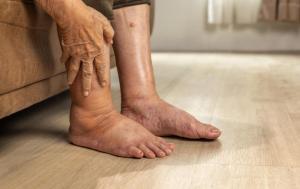
A brownish, reddish-brown, or rust-colored stain near the ankle bone that never quite fades is one of the most telling advanced signs of vein disease. On darker skin tones it may look more like diffuse darkening or hyperpigmentation.
What is happening beneath the surface: sustained pressure ruptures small vessels, and iron from the blood deposits into the surrounding skin tissue. This is called hemosiderin staining, and unlike a bruise, it does not resolve on its own. In more advanced cases, the skin begins to harden and take on a leathery texture as the tissue breaks down — a condition that makes the lower leg feel tight even without any open wounds.
Many people treat this discoloration with moisturizers or steroid creams for months before realizing it is not a skin problem. It is a circulation problem. The skin will not improve until the underlying vein is treated.
For a detailed look at what this discoloration looks like, see Hemosiderin Staining: Causes and Symptoms.
Venous Stasis Dermatitis: The Rash That Keeps Coming Back
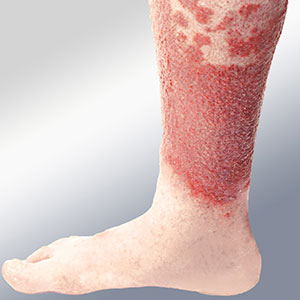
When blood leaks from damaged veins into the surrounding tissue, the body mounts an immune response. The result is a red, itchy, scaly, or weeping rash on the lower legs and inner ankles — one of the most frequently misdiagnosed conditions in vein disease.
People treat it as eczema or contact dermatitis for months, sometimes years. Steroid creams provide temporary relief before the rash returns. It returns because the source of the irritation is the damaged vein, not the skin. Until the vein is treated, the rash cannot resolve.
If you have a recurring rash on your lower legs concentrated near the ankles — particularly alongside any other leg symptoms — ask specifically whether your veins have been evaluated. This is often where the correct diagnosis is finally made.
Venous Ulcers: Open Wounds That Will Not Close
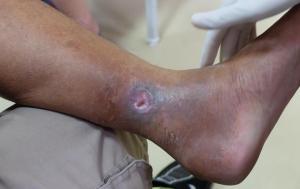
A venous ulcer is an open, non-healing wound, typically on the inner surface of the lower leg just above the ankle bone. The surrounding skin is usually thickened, discolored, and tender. The wound may weep, crust, or stay raw for weeks or months without closing.
Unlike wounds from an injury, venous ulcers do not follow a normal healing timeline. Without treatment of the underlying vein problem, they frequently do not close. Each year approximately 1 in 50 adults with varicose veins develops complications this serious.3 In people with diabetes or reduced sensation in their legs, venous ulcers carry significant infection risk. Prompt specialist care is essential at this stage.
Who Is Most Likely to Develop Vein Disease
Vein disease is not random. Certain factors make it significantly more likely, and having two or more together raises that risk further.2
| Risk Factor | Why It Matters |
|---|---|
| Family history | If one or both parents had varicose veins, your risk is significantly higher. Weakness in vein walls and valves is often inherited.2 |
| Being female | Hormonal changes — including those from pregnancy, birth control, and menopause — relax vein walls and increase susceptibility. Women are affected roughly twice as often as men.2 |
| Pregnancy | Increased blood volume and pressure on the veins in the pelvis and legs can cause new varicose veins to develop. This occurs in up to 28% of pregnancies.2 |
| Age 50 and older | Vein walls lose elasticity and valve function declines naturally with age. Risk increases steadily after 50.3 |
| Carrying excess weight | Extra abdominal pressure pushes down on the leg veins, making it harder for blood to return to the heart. Losing weight can reduce that pressure.3 |
| Sitting or standing for long periods | When legs stay still for hours, the calf muscles that help pump blood upward are not working. Nurses, teachers, office workers, and retail workers face elevated risk. |
| A prior blood clot | A clot in the deep veins can permanently scar the vein valve, leaving it unable to function correctly. Up to half of people who have had a clot go on to develop chronic vein problems.3 |
| Smoking | Damages vein walls and impairs circulation. Quitting reduces the risk of further progression. |
When to See a Vein Specialist
Vein disease does not resolve on its own. The valves that have failed cannot repair themselves. Most people wait years before seeking evaluation, attributing their symptoms to aging or lifestyle. Caught early, it is highly manageable — most procedures take under an hour, require no hospital stay, and are covered by most insurance plans including Medicare and Medicaid when the condition is medically documented.
If three or more of the following apply to you, a vein evaluation is worth scheduling:
- Legs feel heavy or weighted by afternoon, especially after standing or sitting
- Leg cramping or restless legs that disturb your sleep
- Ankle swelling that builds through the day and improves overnight
- Spider veins that itch, burn, or have been spreading
- Visible raised or twisted veins that are tender or growing
- Skin near the ankles that has darkened, thickened, or developed a rash that keeps returning
- A sore on the lower leg that is slow or impossible to heal
The evaluation begins with a duplex ultrasound — a 30-minute, non-invasive scan that maps blood flow and valve function throughout the leg. No needles. No hospital stay. It identifies exactly where the problem is occurring before any treatment decision is made.
Vein Evaluation at USA Vein Clinics
USA Vein Clinics is a national network of 168+ IAC-accredited outpatient vein clinic locations. Our vein specialists use duplex ultrasound to identify the source of your symptoms before recommending any treatment. All procedures are minimally invasive and performed in an outpatient setting — no surgery, no hospital stay. Most patients return to normal activities the same day.
Medical References
- Cleveland Clinic. Chronic Venous Insufficiency: Causes, Symptoms and Treatment. my.clevelandclinic.org/health/diseases/16872
- Patel SK, Surowiec SM. Venous Insufficiency. StatPearls. NCBI. pmc.ncbi.nlm.nih.gov/articles/PMC5886767
- Zhu S, Labropoulos N. Venous Insufficiency. StatPearls. NIH. ncbi.nlm.nih.gov/books/NBK430975
- Zegarra TI, Tadi P. CEAP Classification of Venous Disorders. StatPearls. NCBI, 2023. ncbi.nlm.nih.gov/books/NBK557410