

Medically reviewed by
USA Vein Clinics Medical Review Team
Vascular Surgeons and Vein Specialists
Reviewed: September 2026
Prolonged standing can contribute to varicose veins, though it is one of several risk factors rather than the only cause. Varicose veins form when the small one-way valves inside your leg veins weaken or become damaged. Blood that should move upward toward your heart begins to flow backward and pool, causing veins to stretch, twist, and bulge beneath the skin. When you stand for long periods without moving, your leg muscles are largely inactive, which reduces the natural pumping action that helps push blood upward. Over time, this added pressure can stress already vulnerable veins and accelerate the development of vein disease symptoms associated with underlying venous insufficiency.
Research confirms the connection. A large prospective study following over 9,600 working-age adults found that those who stood for most of their workday had a significantly elevated risk of hospitalization for varicose veins compared with workers in other positions.[1] Nurses, teachers, retail employees, restaurant staff, and hairstylists are among the occupational groups most commonly affected. This does not mean standing will cause varicose veins in every person – genetics, age, pregnancy, and other factors all play a role – but it does mean that people who spend long hours on their feet should pay attention to early leg symptoms.
Symptoms like leg heaviness, aching, or swelling that regularly appear after a long shift are worth taking seriously. These feelings can be the first outward sign that venous blood flow in the legs is not working as efficiently as it should. Understanding the connection between your work habits and your vein health is the first step toward protecting both.
How Standing Affects Your Veins
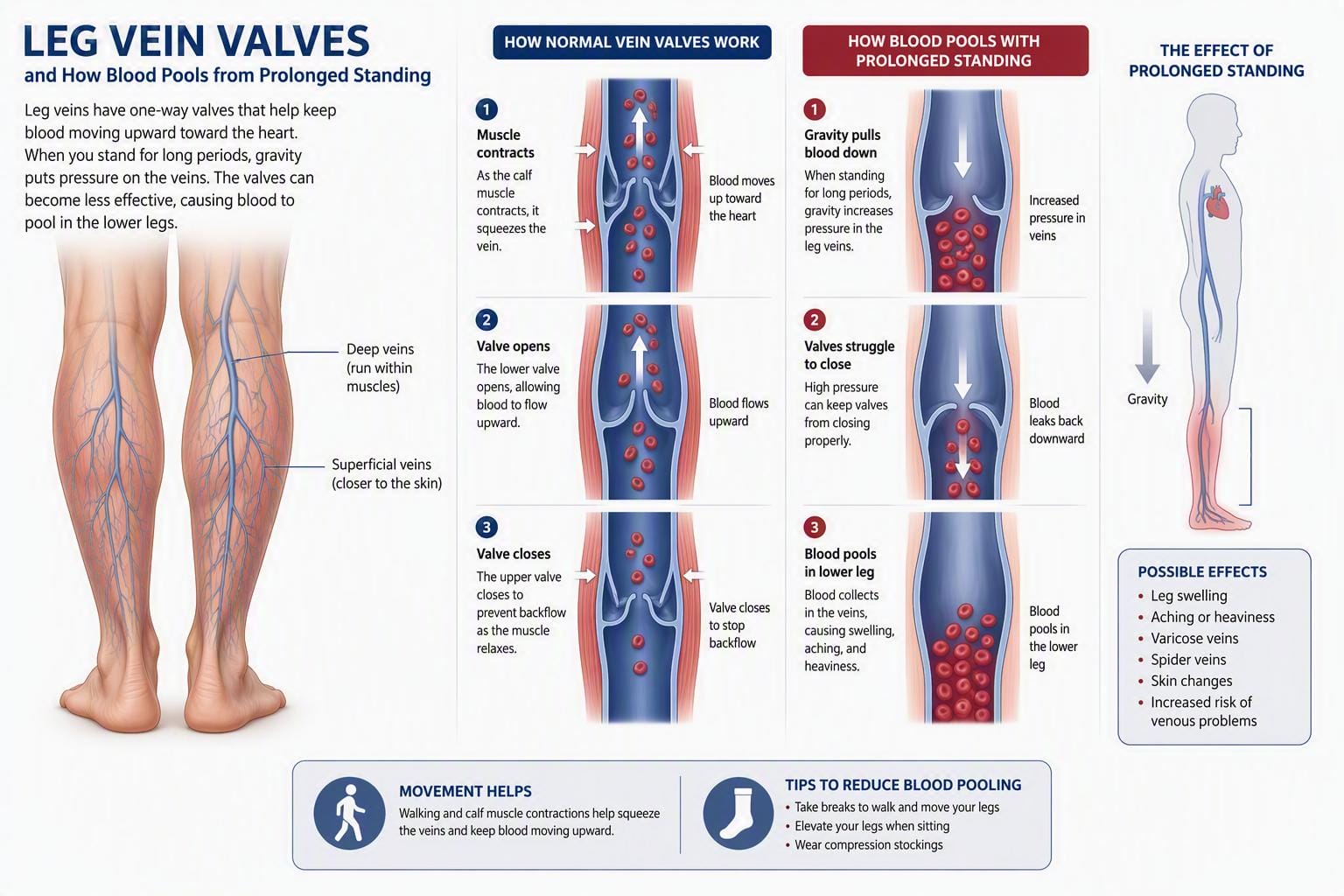
The Role of Vein Valves and Venous Pressure
Your leg veins face a challenge that no other veins in the body deal with quite the same way: they must move blood upward against gravity with every heartbeat. To do this, they rely on a system of tiny one-way valves. These valves open to let blood flow toward the heart, then snap shut to prevent it from sliding back down. When the valves work properly, blood keeps moving. When they weaken or fail, blood accumulates in the lower legs – a condition called venous reflux, which is the underlying driver of chronic venous insufficiency (CVI).
Standing still increases the pressure inside leg veins significantly. That sustained pressure does not damage valves instantly, but over months and years it contributes to valve fatigue. Veins that are repeatedly overfilled with pooled blood eventually stretch beyond their normal diameter, becoming visibly enlarged and twisted. This is how varicose veins form – not from a single episode of standing, but from the cumulative effect of excess venous pressure over time.
Why Static Standing Is Harder on Veins Than Walking
Walking activates the calf muscles, which act as a secondary pump for venous return. Each step squeezes the deep leg veins and pushes blood upward toward the heart. This calf muscle pump can meaningfully reduce venous pressure in the lower legs during normal activity. Standing in one place bypasses this mechanism almost entirely. The calf muscles are not contracting, so blood pools in the lower legs with little assistance from the body’s natural pumping action.
This is why someone who walks on their feet all day may experience fewer vein symptoms than someone who stands at a fixed station for the same number of hours. Movement matters. Even brief periods of walking between standing tasks can help reduce venous pressure and support healthier circulation in the legs.
Other Risk Factors for Varicose Veins
Standing is a meaningful contributor to varicose vein development, but it rarely acts alone. Family history is one of the strongest predictors – if a parent or sibling has varicose veins or venous insufficiency, your likelihood of developing them is significantly higher than average.
Age also plays a role. Vein valves naturally weaken over time, which is why varicose veins become more prevalent in adults over 40. Sex is another factor – women develop varicose veins at higher rates than men, partly due to hormonal influences on vein wall elasticity. Pregnancy increases the volume of blood in the body and places additional pressure on the pelvic veins, which can reduce blood return from the legs.
Excess body weight places similar pressure on the venous system, and a prior leg injury or blood clot can also damage valves directly. For people who stand for work, these additional risk factors compound. Someone with a family history of vein disease who also stands for eight hours a day faces a higher cumulative risk than someone with the same job and no family history. Awareness of your personal risk profile can help guide when to seek a vein evaluation.
How to Support Healthy Circulation If You Stand for Work
Standing jobs are not going away, and for most people they are not optional. Several practical adjustments can help reduce the impact of prolonged standing on venous health.
Move regularly. Taking a short walk every 30 to 60 minutes activates the calf muscle pump and helps clear blood that has accumulated in the lower legs. Even walking in place or shifting your weight periodically can make a difference during stretches when leaving a workstation is not possible.
Wear graduated compression stockings. These are specifically designed to apply the most pressure at the ankle and gradually less pressure up the leg, which helps push blood toward the heart. A vein specialist or primary care provider can recommend the appropriate compression level for your needs.
Elevate your legs during rest periods. Raising your legs above heart level for 15 to 30 minutes can help drain pooled blood from the lower legs and reduce the aching and heaviness that often builds throughout a long shift.
Stay active outside of work. Regular exercise – particularly activities that engage the calf muscles, like walking, cycling, or swimming – supports overall venous circulation and helps reduce the cumulative pressure on leg veins over time. These measures can help slow the progression of vein symptoms and provide daily relief, but they do not correct damaged vein valves. If symptoms persist despite lifestyle adjustments, a vein evaluation may be the appropriate next step.
When Persistent Symptoms May Signal Underlying Vein Disease
Leg fatigue and mild discomfort after a long day of standing are common. Certain symptoms suggest that something more than everyday tiredness may be happening. These include aching, heaviness, or throbbing in the legs that appears consistently after standing and does not resolve fully with rest or leg elevation. Visible varicose vein symptoms – raised, twisted, blue or purple veins on the legs, ankles, or feet – are also worth attention, along with leg swelling that worsens as the day progresses, nighttime cramping, or skin changes near the ankles such as itching, dryness, or reddish-brown discoloration.
These symptoms align with signs of chronic venous insufficiency (CVI). CVI develops when venous reflux becomes persistent and circulation in the leg veins is consistently impaired. Unlike temporary post-shift discomfort, CVI does not resolve on its own – and the valve damage that causes it does not repair itself without treatment.[2]
A duplex ultrasound evaluation performed by a vein specialist can confirm whether venous reflux is present and how significantly it is affecting blood flow. This painless, imaging-guided test takes less than an hour and can identify the specific veins where valve function has broken down. If reflux is confirmed, minimally invasive treatment options – including endovenous laser treatment (EVLT), radiofrequency ablation, and others – are available on an outpatient basis with minimal downtime.
People who work standing jobs and notice these symptoms are not simply experiencing the side effects of a hard day’s work. The patterns described above can indicate that underlying vein disease is developing. Early evaluation tends to produce better outcomes than waiting until symptoms become severe. A vein specialist can review your history, examine your legs, and determine whether further investigation is warranted.
Treatment Options
Your Vein Symptoms Deserve a Real Answer.
Standing for long hours places real stress on your veins. If you are noticing leg aching, swelling, or visible varicose veins after your shifts, those symptoms are worth exploring – not dismissing.
USA Vein Clinics offers minimally invasive, outpatient vein treatment performed without general anesthesia and with minimal downtime. A vein specialist can evaluate your symptoms and discuss which options may be right for you.
Frequently Asked Questions About Standing and Varicose Veins
- Tuchsen F, Krause N, Hannerz H, Burr H, Kristensen TS. Standing at work and varicose veins. Scand J Work Environ Health. 2000 Oct;26(5):414-420. pmc.ncbi.nlm.nih.gov/articles/PMC1740939/
- National Heart, Lung, and Blood Institute. Varicose Veins: Causes and Risk Factors. nhlbi.nih.gov
- WebMD Medical Reference. Understanding Varicose Veins: The Basics. Reviewed June 2026. webmd.com
- Tuchsen F, et al. Prolonged standing at work and hospitalisation due to varicose veins: a 12-year prospective study. Occup Environ Med. 2005;62:847-850. pmc.ncbi.nlm.nih.gov/articles/PMC1740939/
Medical disclaimer: This article provides educational information about vein disease and treatment options. It is not a diagnosis or medical advice. Only a qualified vein specialist can determine whether you have vein disease or recommend appropriate treatment. If you have leg swelling, pain, or other vascular symptoms, consult a healthcare provider or contact USA Vein Clinics for an evaluation.


